On the night of November 15, 1966, two young married couples went driving around Point Pleasant, West Virginia, and ended up in the last place anyone should go for fun: the TNT Area. It was a former World War II munitions site, a sprawl of concrete bunkers called igloos sitting in the woods like a movie set nobody bothered to strike. Roger and Linda Scarberry and Steve and Mary Mallette were looking for a little excitement. They found some.
According to the couples, something was standing beside the road. It was shaped like a man but bigger, somewhere around seven feet tall, with wings and eyes that glowed red in the headlights. Roger hit the gas, and what happened next is why we are still talking about it. They said they topped 100 miles per hour while the creature took flight, kept pace with the car, and screeched at them all the way to the Point Pleasant city limits. They drove straight to the sheriff.
The next day the Point Pleasant Register ran the first newspaper report under a headline that tells you the editors had no idea what to call it: “Couples See Man-Sized Bird… Creature… Something.” A name came soon enough. The thing had wings and red eyes and nothing whatsoever to do with moths, but the Batman TV show was a hit that season, and folklore writers generally blame the comic-book craze for what happened next. The monster became the Mothman.
The Gravediggers Got There First
Here is the wrinkle that gets too little love. Three days earlier, on November 12, five men digging a grave in a cemetery near Clendenin, dozens of miles away, said a brown, human-shaped figure had lifted out of the trees and glided over their heads. One of them, Kenneth Duncan, mostly kept it to himself until the Point Pleasant story broke and he decided to speak up. That is how most legends get built. The pieces do not look like a pattern until somebody hands you the pattern.
A Whole Town Looks Up
After that, Point Pleasant started looking up. Over the next year, more than a hundred people reported seeing something strange in the area. Newell Partridge, a contractor living in Salem, said his TV started buzzing the same night as the Scarberry sighting, and that his German shepherd, Bandit, went out into the dark and disappeared. Partridge told the sheriff that when he aimed a flashlight into a field, he saw eyes glowing like a pair of bicycle reflectors.
| Nov 12, 1966 | Five gravediggers near Clendenin see a figure glide over the cemetery. |
| Nov 15, 1966 | Scarberry and Mallette couples report a red-eyed, winged figure near the TNT Area. |
| Nov 16, 1966 | The Point Pleasant Register prints the first newspaper report. |
| 1966 to 1967 | More than a hundred people report sightings in the area. |
| Dec 15, 1967 | The Silver Bridge collapses at rush hour. Forty-six people die. |
Then the Bridge Came Down
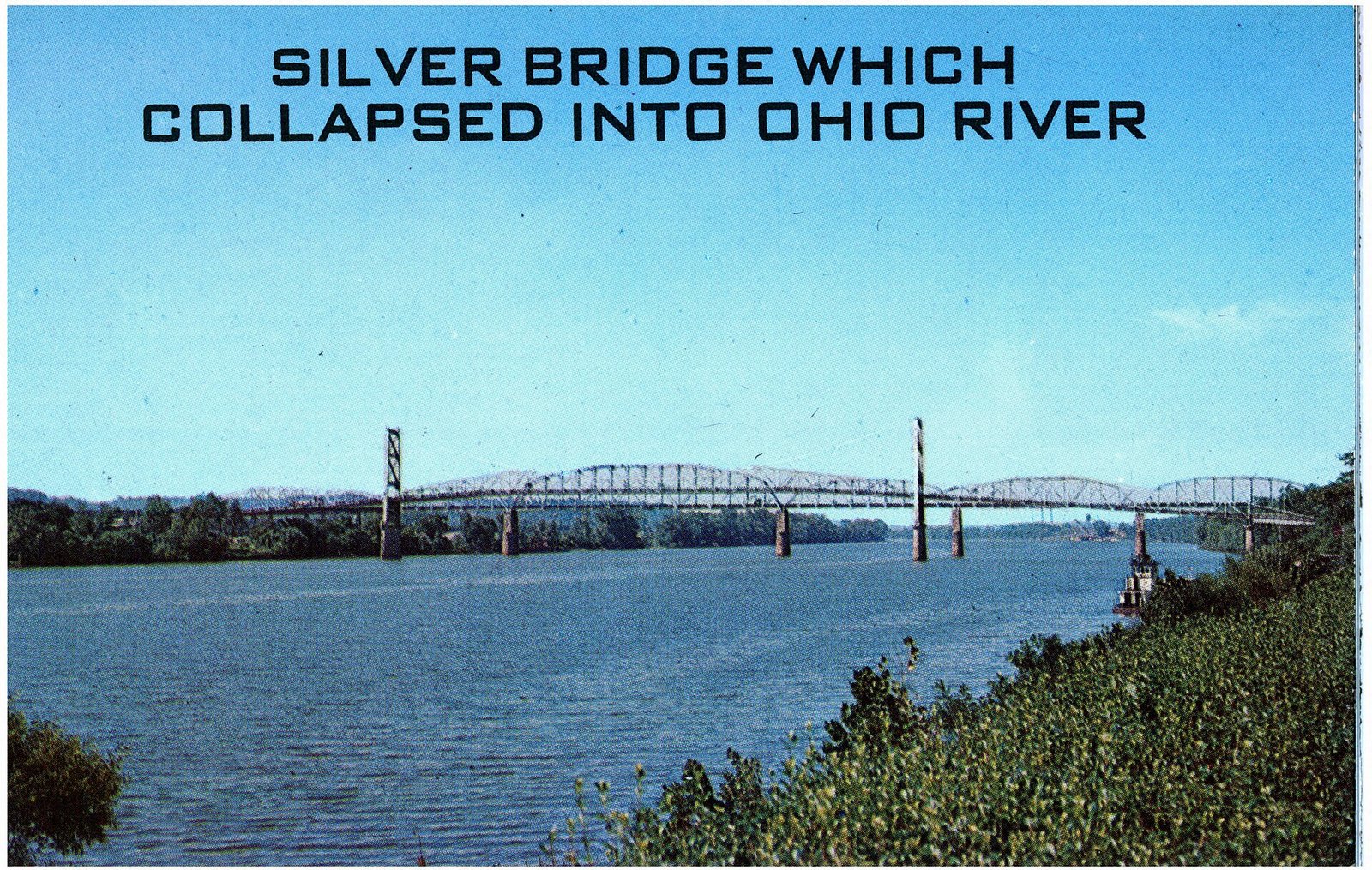
On December 15, 1967, at about 5 p.m., in the thick of rush-hour traffic and Christmas shopping, the Silver Bridge between Point Pleasant and Gallipolis, Ohio, fell into the Ohio River. It took about a minute. Forty-six people died.
That is where this could have stayed a tragedy and a strange local rumor. But writer John Keel, who investigated the sightings, built a book out of it. His 1975 bestseller, The Mothman Prophecies, tied the sightings to the collapse and cast the creature as a harbinger. A 2002 film with Richard Gere put it on the big screen and made it permanent.
The less cinematic explanation is the real one. The National Transportation Safety Board traced the collapse to a cleavage fracture in a single eyebar, a flaw nobody could have found by looking, in a design with very little backup. The disaster led Congress to create national bridge inspection standards in 1968, and they are still in use. If you want a hero in this story, it is the engineers who rewrote the rules. Maybe the Mothman was trying to warn everyone. If so, it was a terrible communicator.
Okay, But What Was It?
Skeptics have offered plenty. West Virginia University wildlife biologist Robert L. Smith pointed to a sandhill crane: nearly human height, a seven-foot wingspan, and reddish skin around the eyes, possibly off its usual route. The local sheriff, George Johnson, floated an unusually large green heron. Investigator Joe Nickell argues for barred owls, with the glowing eyes explained by eyeshine.
Add the setting: a dark, abandoned bomb factory on a cold November night, four young people already hoping to be spooked, and a newspaper hungry for a story. Once a town has a monster, every pair of reflective eyes gets assigned to it. That does not explain the gravediggers or the dog, and it does not make the original four any less sincere. But it does explain how a handful of sightings can snowball into a hundred.
Point Pleasant, for its part, has chosen joy. There is a 12-foot metallic Mothman statue downtown, a Mothman Museum, and a festival every September that draws thousands. The TNT Area is now the McClintic Wildlife Management Area, open to the public. If you go, go in daylight, bring a flashlight anyway, and keep an eye on the treeline. You know. Just in case it is a crane.
Sources
- WikipediaMothman
- PBSMothman: America’s Notorious Winged Monster
- WV ExplorerDid the legendary Mothman first appear at Clendenin cemetery?
- NPREarlier Disaster Led to Focus on Bridge Safety
- e-WV, West Virginia EncyclopediaSilver Bridge Collapse